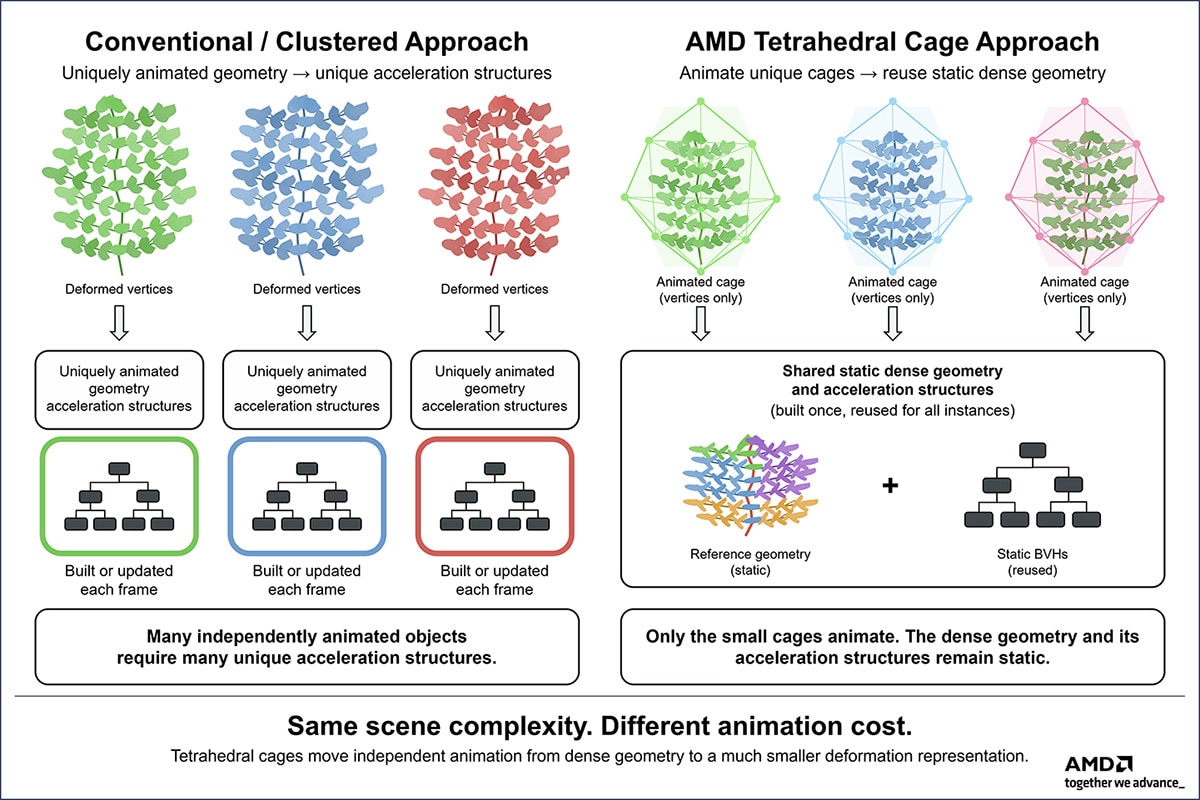
Figure 1. Independently animated dense geometry requires unique acceleration-structure state, while tetrahedral cages keep dense geometry and BVHs static and reusable.
What’s in it: A deeper look at the tetrahedral cage technique for ray tracing dense, independently animated geometry (foliage, grass, crowds) without rebuilding a unique BLAS per object. Instead of animating the dense mesh directly, you animate a compact tetrahedral cage and reuse a static mini-BLAS, keeping the expensive acceleration structures fixed while the cage deforms.
Why it matters to you: If you’re hitting GPU memory or per-frame update ceilings on scenes with lots of independently animated objects, this is a concrete alternative to per-object BLAS updates or cluster-level acceleration structures. The blog includes a demo video showing the cage-based animation in action alongside the memory/timing comparison.
Key result: On a Radeon RX 9070 XT, the tetrahedral cage approach used ~1.7 GB of BVH memory and ~3.3ms per frame for BVH updates, versus up to 80GB of GPU memory and 300ms+ per frame for conventional dense triangle BLAS updates on the same scene.