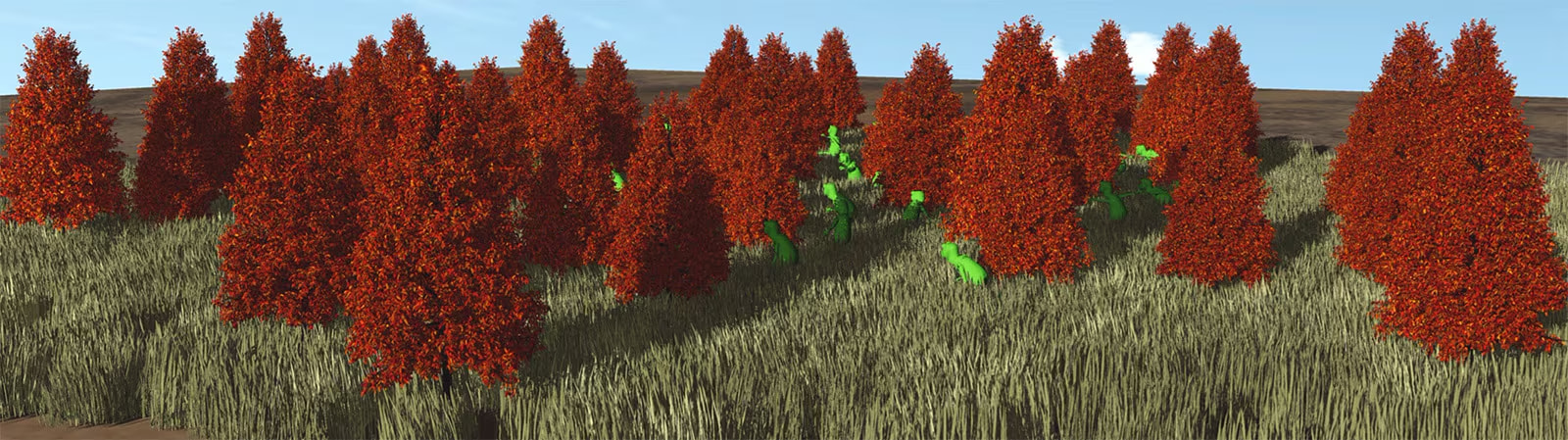
Ray tracing has become a practical part of real-time graphics, but animated geometry still presents a difficult scaling problem. The paper tackles a common production case: scenes with many complex objects that all deform differently.
Learn about:
 Tetrahedral cages decouple animation cost from triangle count
 Enables massive animated scenes in real-time ray tracing
 Read the full publication on GPUOpen.
3 Likes
Interesting work. I guess with ray tracing we can improve the Simulation Performance of Genesis Robotics Simulator or create a simulator and training platform for robotics
1 Like
The real challenge is maintaining efficient acceleration structures when topology and vertex positions change continuously. For highly deformable scenes, methods that minimize BVH rebuilds or support fast refitting could make a major difference to real-time ray-tracing performance.
The tetrahedral cage approach sounds promising for scenes where lots of objects deform at the same time. Reducing the animation cost without tying it directly to triangle count seems especially useful for robotics and simulation workloads. I’d be interested to see how the approach scales with highly complex deforming scenes.