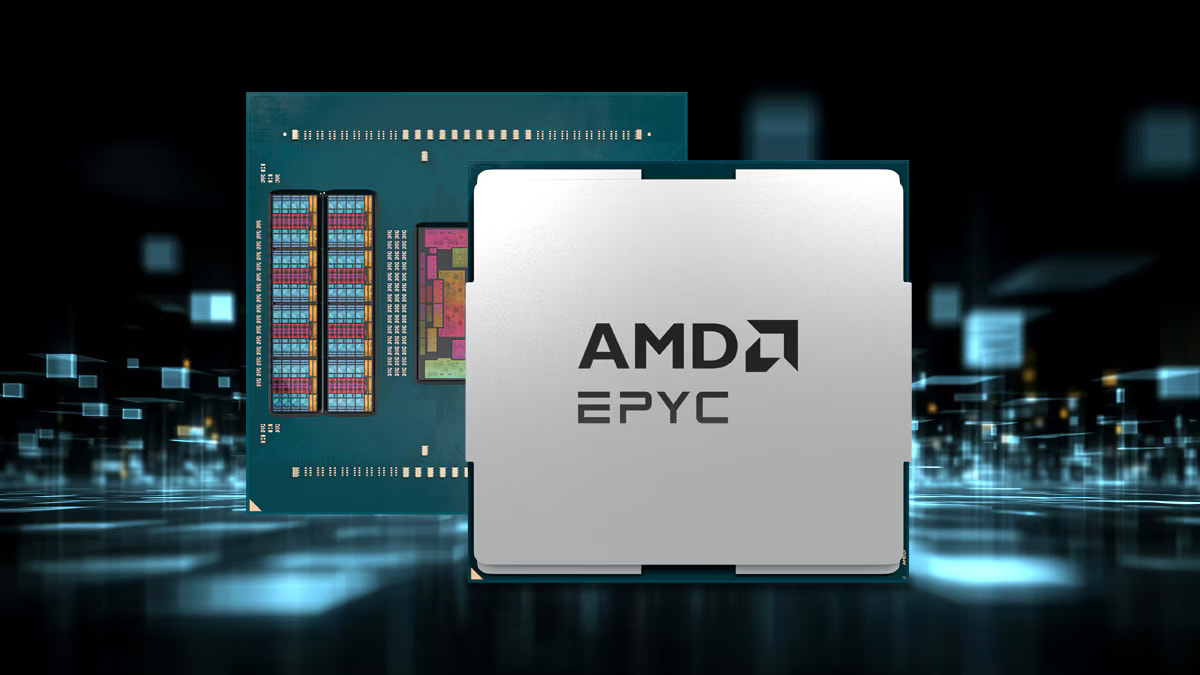
A Cloud Ecosystem Growing With AMD
2025 was a landmark year for AMD EPYC™ CPUs in the cloud. What looks like a long list of cloud deployments is really a single story.
Across hyperscalers, OEMs, cloud service providers, and fast-growing AI clouds, the industry is demanding AMD for performance, efficiency, security features, and scalability.
AWS and AMD: Igniting a New Era of CPU Compute
Since first introducing AMD EPYC CPU-based instances in 2018, AWS has steadily expanded its portfolio. In 2025, it extended that trajectory with a new wave of 5th Gen AMD EPYC CPU–based offerings that Amazon claims provide the highest x86 performance in the AWS cloud.
The latest EPYC CPU-based EC2 families underscore this progress with a set of carefully-tuned instance shapes designed around how organizations operate at scale. EC2 C8a instances advanced memory bandwidth by 33% of the previous generation, while EC2 X8aedz provided double the compute performance over 2nd generation Intel Xeon-based x2iezn instances, helping accelerate complex EDA workloads and shorten design cycles.
Other EPYC CPU-based instances included the memory-optimized EC2 R8a , the high-performance, HPC-focused EC2 Hpc8a , and EC2 M8a that delivers versatile, general-purpose performance.
Across all these new EPYC instance families, developers and enterprises are now able to shift formerly on-premises performance workloads into the AWS cloud and achieve better speed, flexibility, and cost efficiency over previous-generation EPYC CPU-based instances.
Whether powering next-generation analytics, high-throughput databases, scientific modeling, or digital engineering pipelines, AMD EPYC CPU-powered instances in AWS are driving new capabilities that simply weren’t practical at this scale before 2025.